
COP31 and the urgent business of building climate resilience
2 hours, 12 minutes ago
After COP31, IPRA invites PR and communication professionals worldwide to discuss the outcomes at its free virtual debrief on 24 November 2026 REGISTER HERE.
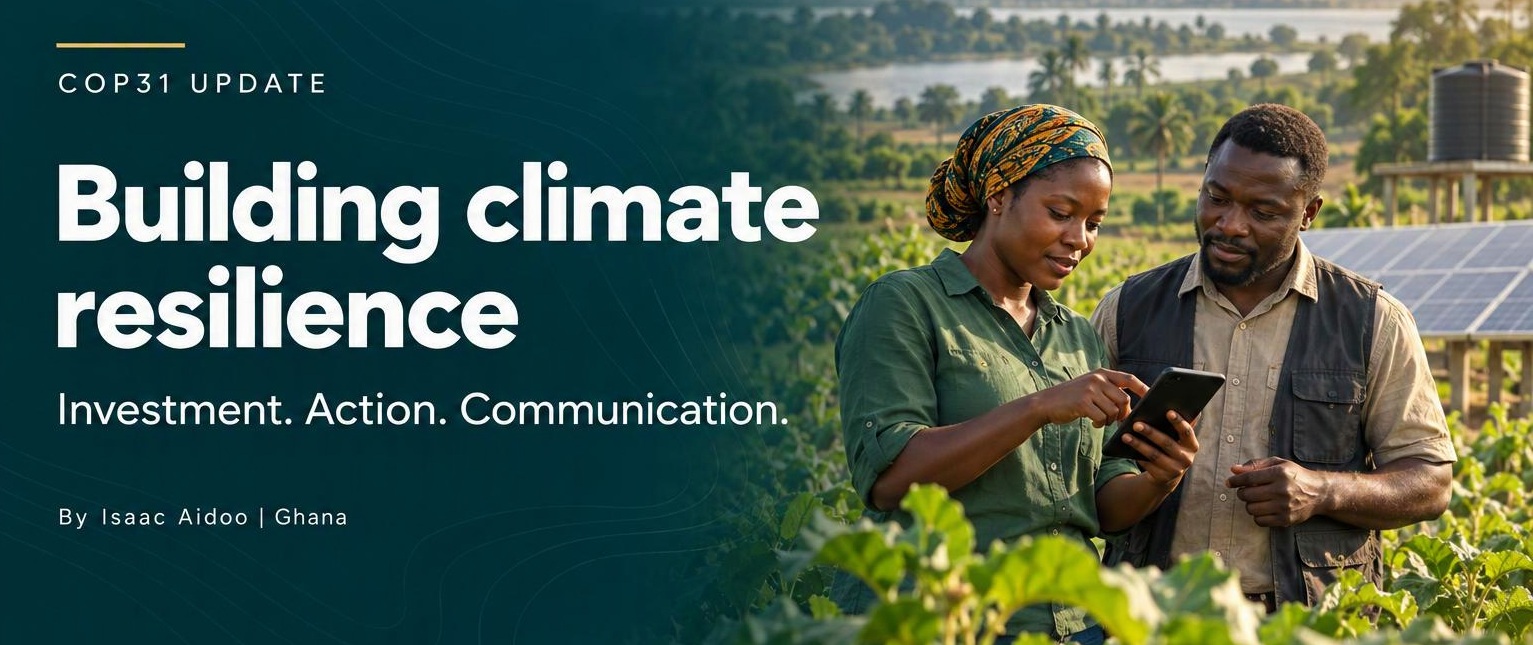
{Image AI generated}
COP31 and the urgent business of building climate resilience
By Isaac Aidoo, Ghana
As world leaders call for faster implementation, Africa's experience highlights the need to connect climate investment, business responses and communication with the needs of vulnerable communities.
The climate transition is creating new economic opportunities, but it is also forcing countries and businesses to make difficult choices about energy, investment and resilience.
At COP31 in Antalya, Türkiye, world leaders are calling for climate commitments to translate into practical results for economies and the people who depend on them.
Discussions since the conference opened have focused on energy security, climate finance, disaster preparedness and economic resilience. Climate change is no longer just an environmental concern. It is affecting government budgets, business costs, food production, infrastructure and livelihoods.
For Africa, the stakes are particularly high as the continent’s experience in renewable energy, climate adaptation, resilient agriculture and community-based responses also offers lessons for the wider world.
For businesses and communication professionals, the challenge is to connect climate investment with practical responses and ensure that communities receive information they can understand and trust.
Climate action: An economic imperative
UN Climate Change Executive Secretary Simon Stiell argues that climate action has become central to national economic security.
He points to progress made through international cooperation, including a reduction in projected global temperature rise. Clean energy investment now exceeds investment in fossil fuels, while adaptation has received greater attention in national development planning.
But progress remains too slow, and its benefits are not being shared fairly.
Stiell warns that climate-related disruptions and dependence on volatile energy markets are putting pressure on economies, contributing to inflation, straining public finances and increasing household costs.
Businesses face similar pressures. Fluctuating fossil fuel prices affect operating costs, while floods, droughts and extreme heat threaten production, infrastructure and supply chains. Investment in clean energy and climate-resilient operations can help reduce these risks while creating opportunities in technology, manufacturing and services.
For African businesses, limited access to affordable finance, technology and reliable infrastructure continues to constrain investment, particularly among small and medium-sized enterprises operating in climate-sensitive sectors.
Businesses need more than encouragement to adopt sustainable practices. They require financing, supportive policies and partnerships that make climate investment possible.
Turning climate finance into investment
COP31 President Murat Kurum calls for a stronger connection between national climate targets and actual investment.
Three priorities are crucial: translating climate goals into investment programs that create jobs and prosperity, improving access to climate finance, and making resilience central to national development planning.
His proposed Climate Implementation Bridge addresses a familiar challenge for developing countries. Governments may identify priority projects in renewable energy, agriculture, water management and infrastructure, but financing difficulties and limited technical capacity often delay implementation. For African countries, investment in irrigation, resilient roads, renewable energy and climate-smart agriculture can protect livelihoods while creating business and employment opportunities.
Communication can save lives
A particularly important message for communication professionals came from UN Secretary-General António Guterres who warned that extreme heat, floods, storms and droughts are claiming lives, destroying livelihoods and reversing development gains.
Advances in science and technology now make it possible to forecast hurricanes, anticipate heatwaves and send alerts directly to mobile phones. Yet millions of people still do not receive warnings in time.
Guterres notes the initiative's goal of ensuring that everyone on earth is protected by an early warning system by the end of 2027.
He cites evidence that countries with comprehensive early warning systems experience disaster death rates nearly six times lower, while a warning issued 24 hours before an event can reduce resulting damage by up to 30 per cent.
Since 2022, approximately US$2 billion has been mobilised for the initiative, with around 160 countries receiving support. However, one in three countries still lacks an early warning system.
His message was that a warning saves lives only when it reaches people in time, is understood and trusted, and leads to action.
This is where climate communication becomes particularly important. Public awareness is necessary, but people also need information that helps them protect their families, homes and livelihoods.
In African communities where farming depends heavily on rainfall, reliable weather information can influence planting decisions, crop management and household incomes. Scientific forecasts and climate warnings must therefore be communicated in language people understand and through channels they can access.
Local authorities, community leaders, farmers' organisations, civil society groups and the media all have a role in ensuring that information reaches those who need it.
Businesses face similar expectations. Investors, customers, employees and host communities increasingly want to know how companies are managing climate risks and reducing their environmental impact.
Africa's place in the climate conversation
Africa's contribution to the climate debate must extend beyond its vulnerability and demand for international support.
Across the continent, countries and communities are exploring renewable energy, adapting farming practices, restoring degraded landscapes and developing ways to manage climate-related risks. These efforts offer practical knowledge about solutions that work under local conditions.
African businesses also have opportunities in renewable energy, sustainable agriculture, resilient infrastructure and improved production systems. Realising these opportunities will require closer cooperation between governments, investors, development partners and communities.
For IPRA and the wider public relations profession, the African experience offers an important perspective on climate communication.
Explaining climate science and reporting international agreements are necessary, but communication must also show how policies affect livelihoods, where investments are going, what businesses are doing and whether governments are delivering on their commitments.
Closing the gap between promises and results
The speeches at COP31 point to a common challenge: closing the gap between climate commitments and the results experienced by countries, businesses and communities.
Stiell's call for economic results, Kurum's emphasis on connecting climate plans to investment and Guterres' focus on early warnings all point to the need for action beyond international declarations.
For Africa, this means ensuring that climate finance supports viable projects, energy investments create opportunities for local businesses, adaptation protects livelihoods and communities receive information they can understand and act upon.
For the communication profession, it means going beyond publicity to explain decisions, promote accountability and build trust.
The credibility of the climate transition will ultimately be judged not by the commitments announced at international conferences, but by the difference they make to businesses, communities and people's lives.
What are key outcomes and what do the results mean for communication? How will we walk away from COP31, and what happens next? Watch out for the last update in a few days!
And join global PR peers on 24 November for COP31 IPRA Debrief: Climate Change, Business and Communication – an African Perspective. Register free today and secure your place: REGISTER HERE
Share on Twitter Share on Facebook